

Feature overview
OpenViking is a context database for AI agents. It organizes resources, memories, skills, and rules as browsable, searchable files. OpenViking supplies context; an agent reads that context to answer questions or carry out tasks.
Start with the quickstart to get an answer you can check against its source. Then choose a task below. You do not need to read every page in sequence.
Start with a task
| Your task | What OpenViking provides | Start here |
|---|---|---|
| Answer questions using project sources | Import, retrieve, and read source content | Resource retrieval |
| Carry background into a new session | Record sessions, extract memory, and recall it for relevant tasks | Memory use |
| Reuse a working method | Store and retrieve a Skill for an agent to read and apply | Skill use |
| Check tasks and actions against requirements | Compile mandatory constraints and recall rules for an agent to check against the current task | Rules (Beta) |
| Organize sources into readable knowledge | Compile sources into a wiki or another Skill-defined output | Context compilation |
Context types
| Type | What it stores | How to check its value |
|---|---|---|
| Resource | External documents, web pages, and code | Key conclusions in an answer can be verified against sources |
| Memory | Background, preferences, and experience extracted from sessions | A new session uses relevant background without you repeating it |
| Skill | Workflow instructions and supporting files | After reading the Skill, the agent produces an output that meets its requirements |
| Rule (Beta) | Mandatory requirements under specific conditions, including obligations, prohibitions, and exceptions | The agent checks applicable rules against task evidence and adjusts its actions or answer |
A viking:// URI identifies content. Read it directly when you know the location; otherwise retrieve matches and open the source. Directory abstracts and overviews support progressive loading; their generation depends on the processing method and configuration.
Rules: For example, “A repository that declares itself open source must provide a locatable license text.” Explicitly compile mandatory requirements from a policy into Rules, then recall them for a specific task. OpenViking supplies the rules and their applicability conditions; the agent uses current evidence to check whether the requirements are met. Rules are in Beta. See Rules for concepts and usage.
Choose an entry point
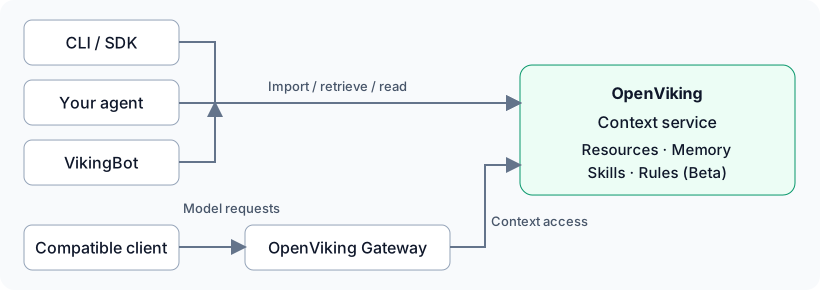
| Entry point | Use it for |
|---|---|
| CLI | Browse, import, retrieve, and read from a terminal; use ov chat with an enabled VikingBot. See CLI basics. |
| Existing agent | Add context and memory to your daily tool. Capture, commit, and recall behavior varies by plugin; verify behavior in a new session after installation. |
| VikingBot | Use the built-in agent for answers and tool-based tasks. The quickstart follows this route. |
| Gateway | Connect a compatible client's model requests to context and memory. Verify the integration through capture, extraction, and recall results. |
| SDK / HTTP | Control import, retrieval, sessions, and data management from your own application. |
OpenViking manages and supplies context. The CLI, plugins, gateway, and agents have distinct responsibilities. For deeper integration, see Agent integrations, Gateway setup, or SDK and HTTP conventions.
Try skills and knowledge organization
Skills: Choose a workflow with a concrete output, install its Skill, confirm the agent can discover and read it, then run a task and inspect the result. OpenViking stores and retrieves the Skill; the agent activates it, manages tool permissions, and executes the task. See Skills for the operations.
Knowledge organization: Prepare sources, compile them with the Wiki Skill, wait for completion, and open an output page to check its evidence and omissions. Skill-based compilation needs a configured Compile Runtime. Compare the output with the original sources to check its accuracy. Continue with the Wiki example.
Next steps
Once you have a result, evaluate your own tasks. If you do not have a service endpoint, compare deployment modes.